


Updates
This form does not yet contain any fields.

    Connect with Jackie


    US National Debt
    Learn more about us debt.
    Campaign Photos

    News Articles

    Thursday
    May102012

    One in Three Young U.S. Workers Are Underemployed

    Young adults more than twice as likely as older adults to be underemployed

    May 9, 2012
    by Dennis Jacobe, Chief Economist


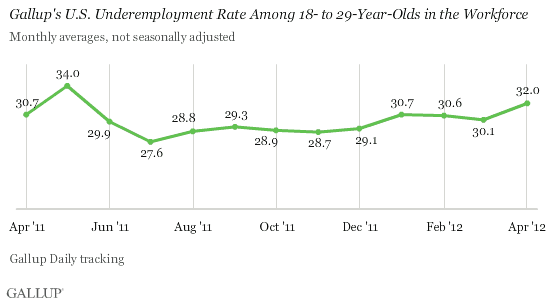
    PRINCETON, NJ -- Thirty-two percent of 18- to 29-year-olds in the U.S. workforce were underemployed in April, as measured by Gallup without seasonal adjustment. This is up from 30.1% in March and is slightly higher than the 30.7% of a year ago.
    zzmypoa3zkstv8vny9y-cw.gif

    These results are based on Gallup Daily tracking interviews, conducted with 28,215 Americans throughout April, including 2,864 respondents aged 18 to 29.

    Gallup's U.S. underemployment measure combines the unemployed with those working part time but looking for full-time work. Underemployment among 18- to 29-year-olds has hovered around 30% for most of the past year, showing no real improvement. Underemployment among all Americans has declined over the past year to 18.2% in April from 19.3% in April 2011.

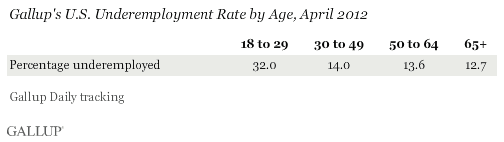
    Young adults were more than twice as likely as those in older age groups to be underemployed in April. Underemployment in April was 14.0% among those aged 30 to 49, 13.6% among those aged 50 to 64, and 12.7% among those 65 or older.
    Gallup's U.S. Underemployment Rate by Age, April 2012

    Unemployment Also Remains Stubbornly High Among Young Adults

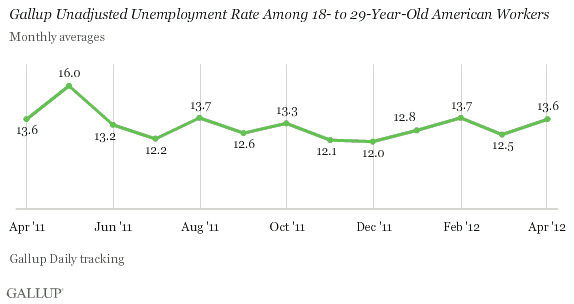
    Unemployment among young adults, as measured by Gallup without seasonal adjustment, increased to 13.6% in April, up from 12.5% in March and the same as in April 2011. Overall unadjusted unemployment declined slightly to 8.3% in April from 8.4% in March.
    qi-ixazhkk-zhffgtzf4eq.gif

    Young adults continue to be much more likely than average to be unemployed; their 13.6% rate in April compares with 7.0% in the 30 to 49 age group, 6.2% among those aged 50 to 64, and 4.9% among those 65 or older.

    More Now Than at Any Time in Past Year Working Part Time, Looking for Full-Time Job

    Another 18.4% of young adults in the workforce were working part time but wanting to work full time in April. This is up from 17.5% in March and 17.1% in April a year ago, and is the highest percentage of part-time young employees looking for full-time work seen during the past year.
    Percentage of 18-to-29-Year-Old Americans Working Part Time but Wanting Full-Time Work, Monthly Averages

    Those in the 30 to 49 (7.0% working part time, but want full-time work), 50 to 64 (7.4%), and 65 and older (7.7%) age groups are much less likely to fall into this part of the workforce.

    Implications

    Wall Street has generally viewed the government's unemployment report for April as a negative for the U.S. economy. Gallup's unemployment measures show that April has also brought gloomy job news for young Americans and underscores that this group has been struggling disproportionately for some time. Those aged 18 to 29 are more than twice as likely as those in any other age group to be underemployed.

    Additionally, while the unemployment rate among young adults in April is unchanged year over year, the underemployment rate has increased. A larger percentage of younger American workers are working part time but looking for full-time work today than were doing so in April 2011. That is, employers appear to be hiring younger Americans in greater numbers on a part-time basis this year than last, possibly in response to the current high level of economic uncertainty.

    Not surprisingly, given their relative lack of resources and experience, only 3.1% of young adults in April say they are self-employed. This compares with the 7.3% of all Americans in the workforce who report being self-employed. Thus, self-employment is also a job alternative that is less available to younger, less experienced Americans.

    Today's slow economic growth is a disaster for those unemployed and underemployed as they look for jobs when so few new jobs are being created. For younger Americans as a group, this is a particularly acute issue. Nearly one in three young adults in the workforce are not now able to gain full-time job experience. This not only hurts them temporarily, but deprives them of the experience they need to get a better job in the future. It also deprives U.S. companies of the skilled and experienced workers they will need for their businesses to prosper in the years ahead.
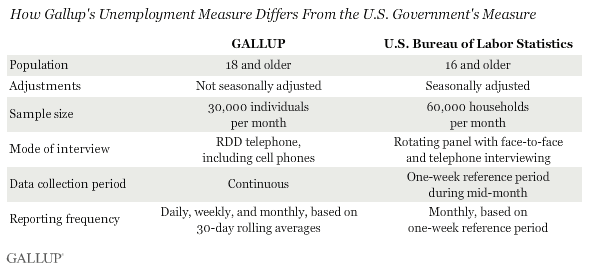
    How Gallup's Unemployment Measure Differs From the U.S. Government's Measure

    Gallup.com reports results from these indexes in daily, weekly, and monthly averages and in Gallup.com stories. Complete trend data are always available to view and export in the following charts:

    Daily: Employment, Economic Confidence, Job Creation, Consumer Spending
    Weekly: Employment, Economic Confidence, Job Creation, Consumer Spending

    Read more about Gallup's economic measures.

    View our economic release schedule.

    Survey Methods

    Results are based on telephone interviews conducted as part of Gallup Daily tracking from April 1-30, 2012, with a random sample of 28,215 adults, aged 18 and older, living in all 50 U.S. states and the District of Columbia, selected using random-digit-dial sampling.

    For results based on the total sample of national adults, one can say with 95% confidence that the maximum margin of sampling error is ±1 percentage point.

    Results for younger Americans 18 to 29 are based on telephone interviews conducted as part of Gallup Daily tracking from April 1-30, 2012, with a random sample of 2,864 adults, living in all 50 U.S. states and the District of Columbia, selected using random-digit-dial sampling.

    For results based on the total sample of national adults, one can say with 95% confidence that the maximum margin of sampling error is ±3 percentage points.

    Interviews are conducted with respondents on landline telephones and cellular phones, with interviews conducted in Spanish for respondents who are primarily Spanish-speaking. Each sample includes a minimum quota of 400 cell phone respondents and 600 landline respondents per 1,000 national adults, with additional minimum quotas among landline respondents by region. Landline telephone numbers are chosen at random among listed telephone numbers. Cell phone numbers are selected using random-digit-dial methods. Landline respondents are chosen at random within each household on the basis of which member had the most recent birthday.

    Samples are weighted by gender, age, race, Hispanic ethnicity, education, region, adults in the household, and phone status (cell phone only/landline only/both, cell phone mostly, and having an unlisted landline number). Demographic weighting targets are based on the March 2011 Current Population Survey figures for the aged 18 and older non-institutionalized population living in U.S. telephone households. All reported margins of sampling error include the computed design effects for weighting and sample design.

    In addition to sampling error, question wording and practical difficulties in conducting surveys can introduce error or bias into the findings of public opinion polls.

    For more details on Gallup's polling methodology, visit www.gallup.com.

    ---
    Read more at Gallup: http://www.gallup.com/poll/154553/One-Three-Young-Underemployed.aspx
    Friday
    May042012

    Jobs Data Point to Sluggishness 


    May 4, 2012

    WASHINGTON — U.S. job growth slowed again in April, a fresh sign that the economy could be settling into a sluggish spring.

    Nonfarm payrolls grew by 115,000 last month, the Labor Department said Friday. The unemployment rate, obtained by a separate survey of U.S. households, ticked down a tenth of percentage point to 8.1%.

    Economists surveyed by Dow Jones Newswires expected a gain of 168,000 in payrolls and for the jobless rate to remain at 8.2% in April.

    On a positive note, March payrolls grew by an upwardly revised 154,000 from an initially reported 120,000, and February payrolls posted a gain of 259,000, compared with an earlier estimate of 240,000.

    The unemployment rate has dropped since August, when it was 9.1%, though some of the decline has resulted from people leaving the work force. Federal Reserve officials have said that they expect only gradual progress the rest of this year. The Fed last week forecast that the unemployment rate would fall to somewhere between 7.8% and 8.0% by the end of this year.

    If the labor market stalls, the Fed could reconsider measures to stimulate the economy. "If unemployment looks like it's no longer making progress, that will be an important consideration in thinking about policy options," Fed Chairman Ben Bernanke said last week.

    Friday's report showed that private companies again fueled the growth, adding 130,000 jobs. Governments, meanwhile, cut payrolls by 15,000.

    Job growth came from a variety of sectors. Professional and business services, which include temporary help, engineering and software design, added 62,000 jobs. The retail sector rebounded, while health care and manufacturing continued to gain. Manufacturers added 16,000 jobs.

    Wages inched ahead. Average hourly earnings rose by one cent to $23.38. Wages were up 1.8% year over year. The average workweek was unchanged at 34.5 hours.

    A broader measure of unemployment—which includes job seekers as well as those stuck in part-time jobs—was unchanged at 14.5%.

    Write to Jeffrey Sparshott at [email protected] and Josh Mitchell at [email protected]

    ---

    Read more at The Wall Street Journal: http://online.wsj.com/article/SB10001424052702304743704577383713904032818.html?mod=WSJ_hp_LEFTTopStories#printMode

    Monday
    Apr302012

    Brooks, Vann and Walorski: Health Care Overhaul Is Wrong for Families 

    By Maggie Brooks, Kim Vann and Jackie Walorski
    Roll Call Editorial 
    April 30, 2012
    http://www.rollcall.com/issues/57_129/-214170-1.html

    As women who have had to balance our families’ checkbooks, we believe we have a unique perspective on how the policies being made in Washington, D.C., will eventually affect average pocketbooks across America. Unfortunately, Washington is broken and only making life harder for families who are already struggling to make ends meet.

    A prime example is the Democrats’ government takeover of health care, and the emerging picture should deeply concern any woman who wants to ensure they have quality health care for themselves and their family. House Minority Leader Nancy Pelosi (D-Calif.) recently called this big-government behemoth the “crown jewel” of the Democrats’ agenda, so it is certainly worth examining how it would affect our families.

    President Barack Obama promised, “If you like your health care plan, you can keep your health care plan,” but the facts now say otherwise. With the government takeover of health care beginning to take effect, it now seems millions of families will be forced to find health care elsewhere when the big-government law applies its mandates and fees. The nonpartisan Congressional Budget Office estimates that as many as 20 million people will be forced from their health insurance plans as the 2010 law takes full effect. This represents an enormous broken promise and a significant intrusion on millions of families and their ability to make their own health care decisions free from government interference.

    For the family pocketbook, the law is contributing to rising health care premiums that are hurting many in these difficult times. Last year, health insurance premiums on average climbed 12.3 percent, and that number isn’t likely to change soon. It should be no surprise that government mandates and $500 billion in new taxes will make health care more expensive, and this is having a devastating effect on family finances that are already stretched thin. Instead of focusing on creating jobs and fixing the economy, the Democrats’ “crown jewel” since they took control of Washington is actively making life harder for families and small businesses across the country.

    For the next generation, the government takeover of health care is proving to be a ticking deficit time bomb and hardly revenue-neutral as Democrats claimed when they passed it. The latest estimates show Obamacare could add up to half a trillion dollars to the deficit, and this is on top of the largest spending spree in history already happening in Washington. Democrats passed their government health care takeover, and both you and your children as future taxpayers will be forced to sacrifice down the line to pick up the tab.

    And yet the Democrats refuse to listen to the objections of American families. House Minority Whip Steny Hoyer (D-Md.) insists that the health care takeover is becoming more and more popular as more provisions of the law come into effect, but polls show the complete opposite is happening. A solid majority of American voters — 53 percent to 39 percent according to a recent ABC News/Washington Post poll — opposes their failed big-government experiment, and opinions of the law are at all-time lows with no end in sight.

    But instead of recognizing this fact, out-of-touch Democratic leaders in Washington remain blissfully ignorant to the outrage voters across the country feel. In fact, Democrats are vowing to make this a key issue in their re-election campaigns, even though the law has only grown more unpopular. 

    What we and millions of families across the country are left with is a string of broken promises that will continue to unravel and make life even harder for families already struggling with the stagnant economy.

    When something sounds too good to be true, it usually is, and the Democrats’ government takeover of health care is a reminder that this is all too common in Washington.

    The stark reality of the law — families forced off their current health insurance plans, rising monthly premiums and soaring costs for taxpayers — should be more than enough to demonstrate why Obamacare must be repealed and replaced with a patient-centered approach instead.

    Pelosi famously said, “We have to pass the bill so you can find out what is in it.” We now know what’s in it, and we’ve had enough.

    Maggie Brooks is a Republican House candidate in New York’s 25th district. Kim Vann is a Republican House candidate in California’s 3rd district. Jackie Walorski is a Republican House candidate in Indiana’s 2nd district.

    Saturday
    Apr072012

    The Worst Economic Recovery in History 

    By EDWARD P. LAZEAR

    How many times have we heard that this was the worst recession since the Great Depression? That may be true—although the double-dip recession of the early 1980s was about comparable. Less publicized is that our current recovery pales in comparison with most other recoveries, including the one following the Great Depression.

    The Great Depression started with major economic contractions in 1930, '31, '32 and '33. In the three following years, the economy rebounded strongly with growth rates of 11%, 9% and 13%, respectively.

    The current recovery began in the second half of 2009, but economic growth has been weak. Growth in 2010 was 3% and in 2011 it was 1.7%. Who knows what 2012 will bring, but the current growth rate looks to be about 2%, according to the consensus of economists recently polled by Blue Chip Economic Indicators. Sadly, we have never really recovered from the recession. The economy has not even returned to its long-term growth rate and is certainly not making up for lost ground. No doubt, there are favorable economic numbers to be found, but overall we continue to struggle.

    During the postwar period up to the current recession (1947-2007), the average annual growth rate for the U.S. was 3.4%. The last three decades have experienced somewhat slower growth than the earlier periods, but even in the period 1977-2007, the average growth rate was 3%. According to the National Bureau of Economic Research, the recovery began in the second half of 2009. Since that time, the economy has grown at 2.4%, below our long-term trend by either measure. At this point, the economy is 12% smaller than it would have been had we stayed on trend growth since 2007.

    Worse, the gap is growing over time. Today, the economy is four percentage points further from the trend line than it was the first quarter of 2009 when this administration's nearly $900 billion fiscal stimulus efforts began. If forecasts of around 2% growth turn out to be accurate, we will add to that gap this year.

    Contrast this weak growth with the recovery that followed the other large recession of recent decades. In the early 1980s, the economy experienced a double-dip recession, with contractions in both 1980 and '82. But growth rates in the subsequent two years averaged almost 6%. The high growth that persisted throughout the 1980s brought the economy quickly back to the trend line. Unlike the current period, from 1983 on, the economy was in rapid catch-up mode and eventually regained all that had been lost during the early '80s.

    Indeed, that was the expectation. As economist Victor Zarnowitz of the University of Chicago argued many years ago, the strength of the recovery is related to the depth of the recession. Big recessions are followed by robust recoveries, presumably because more idle resources are available to be tapped. Unfortunately, the current post-recession period has not followed the pattern.

    The 2007-09 recession was induced by a financial crisis and some, most notably economists Carmen Reinhart and Kenneth Rogoff (authors of "This Time is Different: Eight Centuries of Financial Folly"), argue that financial crises pose more difficult recovery problems than do policy-induced recessions.

    The early '80s recession could be viewed as induced by the Federal Reserve's tight monetary policy (i.e., raising interest rates), which was designed to rein in inflation. Growth returns more rapidly, they argue, when the policy hindering it changes (i.e., the Fed lowers interest rates) than when the economy is struggling after a severe credit crisis like the one we experienced after the 2008 collapse of Bear Stearns.

    But some, Stanford economist John Taylor being their leading spokesman, argue that the current recession was caused by Fed policy as well—rates remained too low for too long in the lead up to the subprime mortgage fiasco. The Great Depression also began with a financial crisis but saw high growth rates following contractionary years, and the output lost in negative years was eventually regained through higher subsequent growth.

    Are there other factors that may have contributed to the slow recovery that we are experiencing? It would be difficult to argue that government polices over the past three years have enhanced confidence in the U.S. business environment. Threats of higher taxes, the constantly increasing regulatory burden, the failure to pursue an aggressive trade policy that will open markets to U.S. exports, and the enormous increase in government spending all are growth impediments. Policies have focused on short-run changes and gimmicks—recall cash for clunkers and first-time home buyer credits—rather than on creating conditions that are favorable to investment that raise productivity and wages.

    There are some positive developments. The labor market is improving, albeit slowly. Profits remain high and the stock market has enjoyed some recent success. We can hope that these indicate better times and higher growth ahead. But unless we move to a set of economic policies that are aimed at growing the economy rather than at promoting social agendas, this may be the first "recovery" in history that fails to see us return to long-term average growth.

    Mr. Lazear, chairman of the President's Council of Economic Advisers from 2006-2009, is a professor at Stanford University's Graduate School of Business and a Hoover Institution fellow.

    ---

    Read more at The Wall Street Journal: http://online.wsj.com/article/SB10001424052702303816504577311470997904292.html

    Monday
    Mar192012

    Two Indiana women may be part of a bumper crop for Congress 

    WASHINGTON -- The enlarged photo that congressional candidate Susan Brooks displays at some of her events shows not Brooks, but Cecil Murray Harden, the last -- and only -- Republican woman from Indiana to serve in Congress.

    Harden left Congress more than half a century ago.

    "In my lifetime, there's never been a Republican woman (from Indiana) in Congress," says former state Rep. Jackie Walorski, 48, who is also running for a House seat. "I think it's kind of weird."

    Only 17 percent of federal lawmakers are women, a rate that ranks behind 77 countries, including Afghanistan, Cuba and Nepal, in the percentage of women in the national legislature.

    And the percentage of women serving in the U.S. House dropped after the 2010 elections, the first decline since 1978.

    But this year's elections could bring a bumper crop of women to Washington. A notable number of candidates running in competitive House and Senate races could make 2012 another "Year of the Woman." That moniker was famously applied in 1992 when four new women were elected to the Senate, a high-water mark for the chamber that has not been surpassed.

    "Both parties have made a concerted effort to attract more women candidates," said Jessica Taylor, a senior analyst for the nonpartisan Rothenberg Political Report. Taylor said campaign operations understand female candidates can be particularly appealing because independent female voters are often a decisive voting bloc in elections.

    In the last presidential election year, 61 percent of eligible Hoosier women voted, compared with 57 percent of eligible men.

    Indiana is one of 27 states that have never elected a woman to the Senate and one of 20 that have no women in its current delegations to the House and Senate. Five Hoosier women have served in the House. The last was Democratic Rep. Julia Carson, who died in office in 2007.

    Of the 61 major-party candidates running for the House from Indiana, seven are women. Of those, Walorski and Brooks are in the best position to win, although both are in competitive races.

    Walorski, Jimtown, is running to succeed Democratic Rep. Joe Donnelly in north-central Indiana, a swing district that likely will be targeted by the national parties. Brooks is one of seven Republicans running in the heavily GOP Central Indiana district seat held by retiring Rep. Dan Burton, R-Indianapolis.

    Walorski, who narrowly lost to Donnelly in 2010, has raised the most campaign funds of any non-incumbent from Indiana. Brooks has raised the second-most.

    In Brooks' first campaign ad, she draws immediate attention to being the only female candidate in her race.

    "I'm running against some good guys," she says in her first words to the camera, before criticizing some of those guys for having run for office multiple times.

    Brooks, 51, Carmel, said the ad's opening line highlights her gender "because people don't have the opportunity to see us all together."

    More than her gender, Brooks said, she's emphasizing the difference in her career path, which includes being a partner in a small law firm, serving as deputy mayor of Indianapolis, serving as a U.S. attorney for the Southern District of Indiana, and being vice president and general counsel for Ivy Tech Community College.

    "I think that my combination of experiences is what I believe has given me the confidence to run for Congress, particularly my last four years at working at Ivy Tech and working in the area of workforce training and economic development and job creation," she said. "I believe it's taken me this long in my career path to feel that I am highly qualified to be a member of Congress."

    It's that lack of confidence in being qualified that is a main reason more women haven't run for office, according to a recent survey of about 4,000 lawyers, business leaders, educators and political activists conducted by two political science professors. The study found a substantial gender gap in political ambition among both Democrats and Republicans.

    "It may well be that women undervaluing their qualifications is a product of them not knowing that when women run for office, they do as well as men," said Jennifer Lawless, an associate professor of government at American University who co-authored the study.

    Harden recognized the same problem in 1949, telling the Washington Post that women wouldn't make real progress in politics until they developed a genuine conviction of their own worth.

    "We must feel in our hearts that women are as competent to assess problems and meet situations as men," she said.

    Anne Hathaway, president of an Indianapolis political consulting firm, said women still approach running for office very differently from men.

    "If you say to a guy, 'Would you be interested in running?' he says yes without looking at the whole big picture," Hathaway says. "A woman immediately thinks, 'Oh, I'm not qualified. I don't know enough. I need to think about it,' and works to make sure that she's qualified."

    Other reasons the survey identified for women seeking office less often than men include:

    Women are encouraged less often than men to run for office.

    Women are still responsible for the majority of child-care and household tasks.

    Women are more risk-averse.

    Women react more negatively to many aspects of modern campaigns.

    "Having been inside of a congressional race and three state House races, I'm not surprised that women don't sign up for the task, especially watching what happens sometimes to women who do sign up," Walorski said. "I would use both Sarah Palin and Hillary Clinton as examples of women at the federal level who endured things that were just horrific -- and that's probably one reason why women shut the door and say, 'There is no way I'm going to put myself or my family through that.' "

    There are many efforts to encourage and prepare women to run for office, including a recently launched Political Parity national campaign aimed at doubling the number of women serving as governors and members of Congress in 10 years.

    Led by former U.S. Ambassador to Austria Swanee Hunt, a Democrat, and former Massachusetts Lt. Gov. Kerry Healey, a Republican, the campaign is working with women's groups to build relationships with one another, share strategies, conduct research and motivate campaign donors.

    In Indiana, the Richard C. Lugar Excellence in Public Service Series has worked since 1989 to cultivate Republican women's involvement in government and politics. More than 400 women have gone through the program, and there are graduates in the state House, in mayor's offices, in Gov. Mitch Daniels' administration and elsewhere.

    Hathaway runs the Lugar series and serves on the board of the Women's Campaign School at Yale University, a leadership program intended to increase the number of women in government. Applications to the program dropped last year but are growing this year.

    "We're trying to discuss whether it's because it's a presidential year and there's more discussion (of government and politics) or why," Hathaway said. "I don't think we know yet."

    Other advocates for increasing women's participation in politics say the problem isn't ambition but identifying public policy issues women care about.

    "Women come into politics because there's a pressing issue they want to solve," said Debbie Walsh, director of the Rutgers University Center for American Women and Politics.

    In addition to being given the photo of Harden from the former congresswoman's family to inspire her campaign, Brooks is getting volunteer help from Harden's great-granddaughter, Betsy, who sometimes introduces Brooks at campaign events.

    Both Brooks and Walorski said they've gotten encouragement from women officeholders, and they feel compelled to encourage other women to run.

    "I was reading a book to a preschool last week, and I was telling some of the little girls that you can grow up to be president of this country. And one little girl was like, 'I'm going to!' " Walorski said. "And I was like, 'You know what? That's great.' Mission accomplished."

    Contact Star Washington Bureau reporter Maureen Groppe at (202) 906-8118 or at mgroppe@ gannett.com.

    Gannett Washington Bureau reporters Brian Tumulty and Susan Davis contributed to this story.

    ---

    Read more at the Indianapolis Star: http://www.indystar.com/article/20120318/NEWS05/203180348/Two-Indiana-women-may-part-bumper-crop-Congress